Stop Building Digital Filing Cabinets
Buying another CRM subscription won't make you data-driven. Scanning invoices into PDFs isn't "digitalization." Let's talk about what actually works.
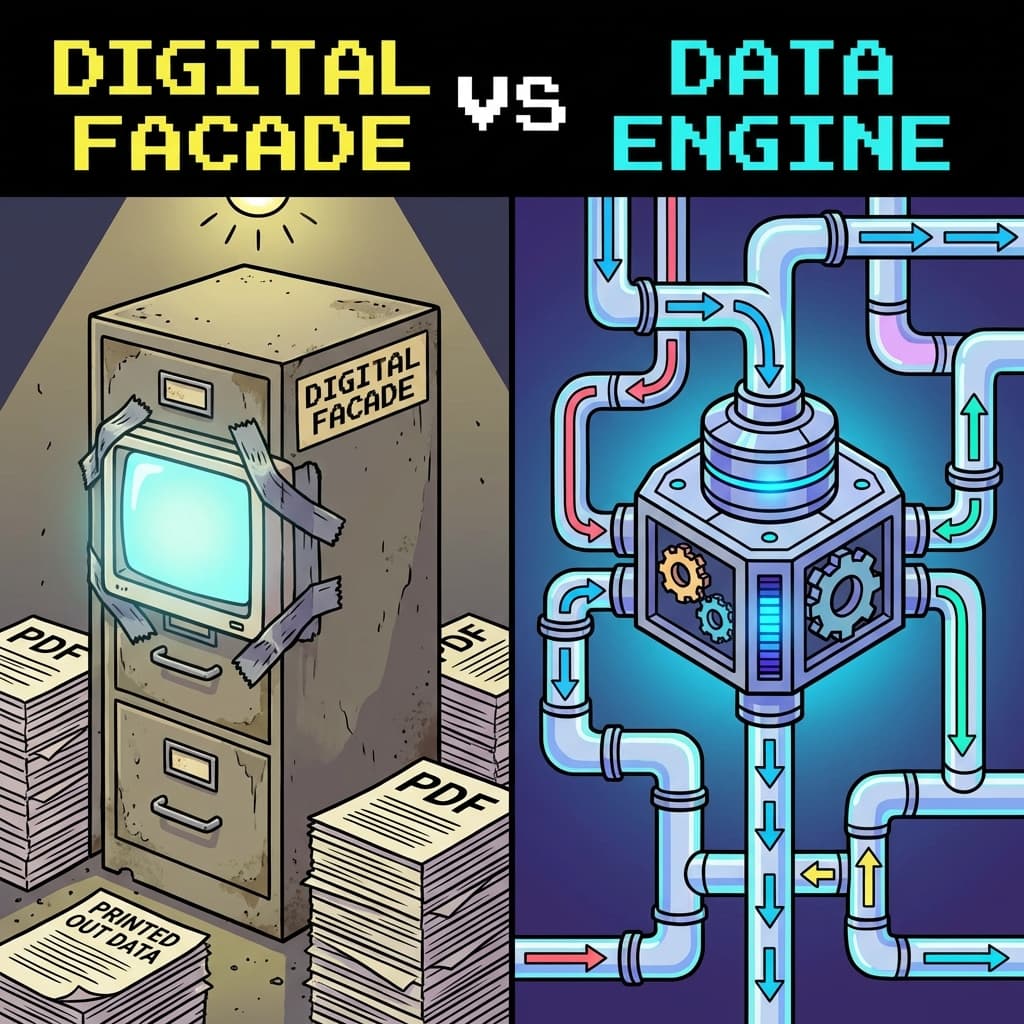
Here's a scene that plays out in thousands of offices every single day:
Sarah opens the CRM, exports to Excel, opens another Excel with the targets, vlookups for 20 minutes, breaks the formula, fixes it, realizes the data doesn't match accounting, emails finance, waits 3 hours, gets a different spreadsheet, starts over...
Two days later: "Here's that report you asked for!"
Sound familiar? You're not alone. This is happening right now in Fortune 500 companies with billion-dollar IT budgets. The tools are modern. The process is ancient.
The Numbers Don't Lie (And They're Brutal)
Let that sink in. Companies are spending $1.3 trillion dollars on "digital transformation," and 73% of the data they collect is never used for anything. It just... sits there. Like a digital hoarder's basement.
Why 70% of Transformations Fail
The answer is painfully simple: we focus on the tech before we fix the process.
Here's the typical "digital transformation" playbook:
- 1Executive reads article about AI/Cloud/Digital
- 2Company buys expensive software
- 3IT spends 18 months implementing it
- 4Employees use it to do... exactly what they did before, just with a fancier interface
- 5Project declared "complete." Nothing actually changed.
You didn't digitalize. You just bought a more expensive filing cabinet.
Digitization vs. Digitalization: The Crucial Difference
These two words sound the same. They are absolutely not.
Turning a paper form into a PDF. Creating an Excel version of a paper ledger. Scanning documents into a folder.
Eliminating the form entirely. Data is born digital, validated at input, and flows automatically into a central system in real-time.
We scanned all our contracts into PDFs, so now we're digital!
You created searchable paper. You still can't query 'show me all contracts expiring in Q3' without manually opening each one.
We use Salesforce/SAP/Oracle, so we're data-driven!
If your team exports data to Excel to do actual analysis, your enterprise software is just a really expensive form.
Our dashboards show real-time data!
If someone has to manually update a spreadsheet that feeds that dashboard, it's not real-time. It's 'whenever-Karen-remembers' time.
Real Companies, Real Transformations
✅ Domino's Pizza: The Gold Standard
In 2008, Domino's was a struggling pizza chain. By 2023, they were a tech company that happens to sell pizza. Here's what they did right:
- Built a single source of truth for every order across all channels
- The "Pizza Tracker" isn't just marketing—it's real-time operational data made visible
- Every interaction (app, web, phone, Alexa) feeds the same data engine
- Result: Stock price went from $3 to $500+ over 15 years
❌ GE Digital: The $7 Billion Lesson
In 2015, GE announced it would become a "top 10 software company." They spent $7 billion on their digital platform, Predix. Here's what went wrong:
- Built the platform before understanding the process
- Tried to be everything to everyone instead of solving specific problems
- Data from industrial machines was collected but rarely actionable
- Result: GE Digital was spun off, CEO fired, stock crashed 80%
The difference? Domino's redesigned the process. GE just bought technology and hoped for magic.
The Actual Playbook: How to Become Data-Ready
To make your organization truly data-ready, you must stop collecting digital paper. Here's the playbook that actually works:
Map the Flow (The Painful Part)
Pick one critical, manual process (e.g., Sales reporting, Expense approvals, Customer onboarding). Now, follow the data.
- Where does it originate? (A form? An email? Someone's head?)
- How many times is it copied/pasted/re-entered?
- Where does it end up? (Usually a dead-end Excel file on someone's desktop)
- How many hours per week does this process consume?
Pro tip: You'll be horrified. That's normal. The average enterprise has data copied 4-7 times before reaching its final destination.
Redesign for Data (The Fun Part)
Ask the magic question: "How can we re-engineer this process so the data is born digital, clean, and connected?"
- Replace the spreadsheet with a web form with validation
- Connect the form to a database, not an inbox
- Add workflow automation (approvals, notifications)
- Build a dashboard that queries live data
The goal: Data is entered once, validated at the source, and instantly available everywhere.
Integrate, Don't Isolate (The Strategic Part)
Ensure this new, clean data flows out of its silo and into a central place where it can be combined with other data.
- Use APIs to connect systems, not CSV exports
- Create a data warehouse or lakehouse for analysis
- Establish data governance: who owns what, what's the source of truth?
The magic happens when you can ask: "Show me customers who bought Product X AND had a support ticket AND are in their renewal window." If that requires three people and two days, you're not there yet.
The ROI is Real (And Measurable)
Time Savings
Companies that properly digitalize report 20-30% reduction in time spent on manual data tasks. That's 8-12 hours per employee per week freed up for actual work.
Better Decisions
Organizations with real-time data access make decisions 5x faster and are 23% more profitable than peers. (Source: MIT Sloan)
The Bottom Line
Stop building digital filing cabinets.
Start building data engines.
The companies that win in the next decade won't be the ones with the most software subscriptions. They'll be the ones who redesigned their processes so that data flows like water—clean, automatic, and everywhere it needs to be.
"I showed you something you might not have known.
You better be better." 💪